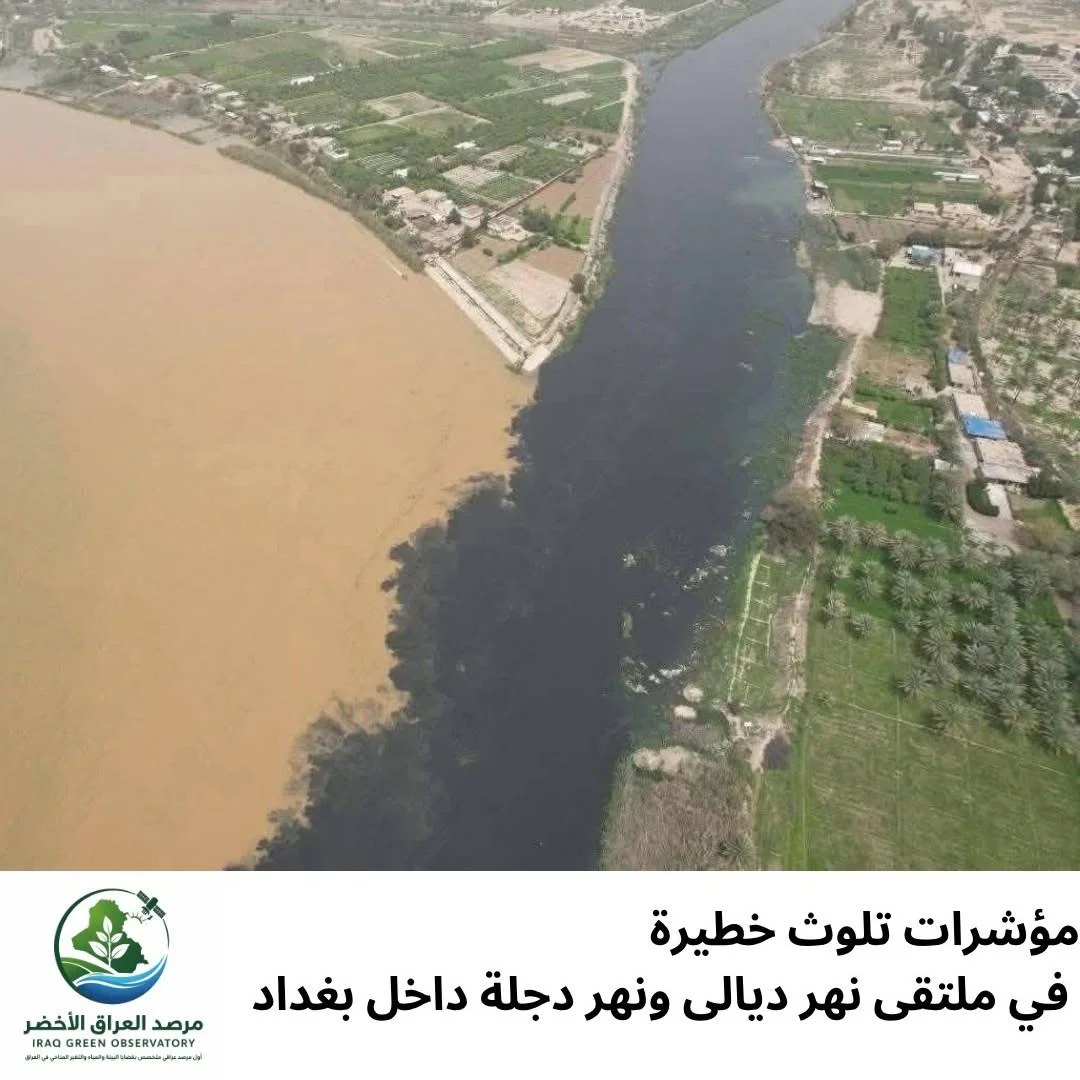
The Iraqi Green Observatory has documented alarming indicators of deteriorating water quality at the confluence of the Diyala River and the Tigris River in Baghdad, where a noticeable darkening of the water has been observed. This suggests elevated levels of pollution, likely resulting from the discharge of insufficiently treated wastewater, particularly from the Rustamiyah area.
This pollution is not confined to the capital. It is carried downstream by the Tigris River toward Iraq's central and southern provinces, posing an increasing threat to water resources, public health, and the country's ecological balance.
These findings point to ongoing challenges in water resource management and wastewater treatment, underscoring the urgent need to strengthen wastewater treatment processes and enhance environmental monitoring to curb the worsening pollution.
Indicators of Declining Strategic Water Reserves
Iraqi Green Observatory: Iraq Is Approaching a State of Water Stress
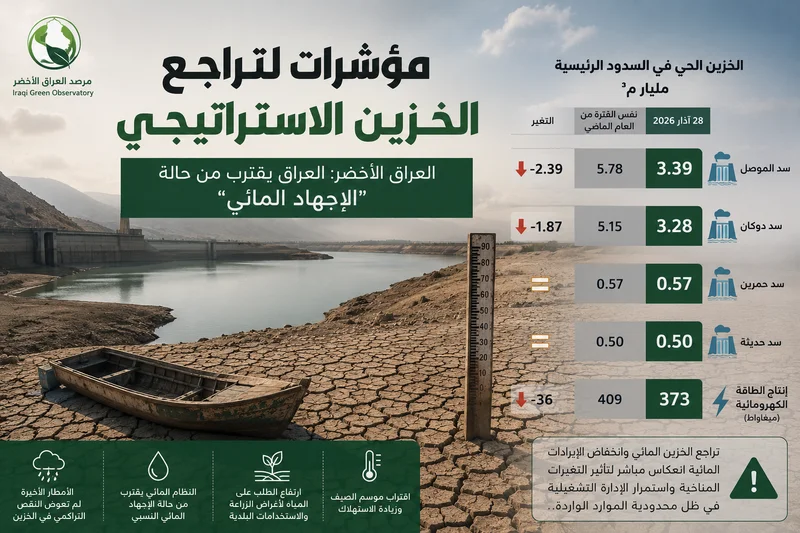
The Iraqi Green Observatory (IGO) has identified growing indicators of a decline in Iraq's strategic water reserves, warning that the country's water system is approaching a state of relative water stress, particularly with the onset of summer, increasing water demand for agriculture and municipal use, and the continued reliance on operational dam management amid limited incoming water resources.
The Observatory stated that there is a clear gap compared with the same period last year, reflecting the fragility of Iraq's water balance and its direct vulnerability to climate change. Despite recent rainfall, precipitation has failed to compensate for the cumulative deficit in the country's strategic water storage.
According to recent official data issued on 28 March 2026 by the government authority responsible for managing Iraq's water resources, water storage has declined across several major reservoirs. Although some regions experienced heavy rainfall and certain lakes and reservoirs recorded slight increases in water levels, overall storage has not risen sufficiently to indicate a meaningful recovery in Iraq's water situation. This points to the continued weakness and instability of the country's water inflows.
The Observatory noted that Mosul Dam recorded a decline in live storage to approximately 3.39 billion cubic metres, compared with 5.78 billion cubic metres during the same period last year. Dokan Dam held around 3.28 billion cubic metres, down from 5.15 billion cubic metres a year earlier. Meanwhile, storage at Hamrin Dam remained at approximately 0.57 billion cubic metres, while Haditha Dam maintained relatively stable levels of around 0.50 billion cubic metres. Hydropower generation also declined to approximately 373 megawatts, compared with 409 megawattsduring the same period last year, reflecting the impact of lower reservoir levels.
From an academic perspective, the Observatory stressed that the recent rainfall should have been better utilised through the adoption of modern water management approaches. These include rainwater harvesting by constructing small reservoirs, retention dams, and underground storage systems; Managed Aquifer Recharge (MAR) through directing surface runoff into groundwater basins; and the implementation of smart water management systems that integrate hydrological models and climate forecasting to improve reservoir storage and water release decisions. The Observatory also highlighted the need to upgrade urban stormwater drainage infrastructure to capture and reuse rainwater instead of allowing it to be lost, while expanding the use of modern irrigation technologies to minimise water losses and improve water-use efficiency.
The Iraqi Green Observatory further emphasised the importance of enhancing water resource management, adopting effective climate adaptation strategies, and diversifying energy sources to reduce dependence on hydropower, while supporting broader efforts to achieve sustainable water resource management across Iraq.
The Observatory noted that this statement is based on numerical data published in official government reports. The information has been analysed and presented solely for environmental awareness and to support informed public discussion, without directly identifying the issuing authority, in accordance with professional standards governing the responsible dissemination of information.
Search Archive
Popular Searches:Tigris Dam, Marsh Salinity, Basra Water, Solar Grid, Climate COP