Iraq Green Observatory: Recurring Fish Die-Offs Expose the Depth of Iraq’s Water and Environmental Crisis
The Iraq Green Observatory (IGO) has warned that recurring fish die-offs in Iraq’s rivers and marshlands have become an annual phenomenon, reflecting the deepening and cumulative nature of the country’s water and pollution crises.
The IGO stressed that the absence of comprehensive and long-term solutions continues to allow the phenomenon to recur year after year.
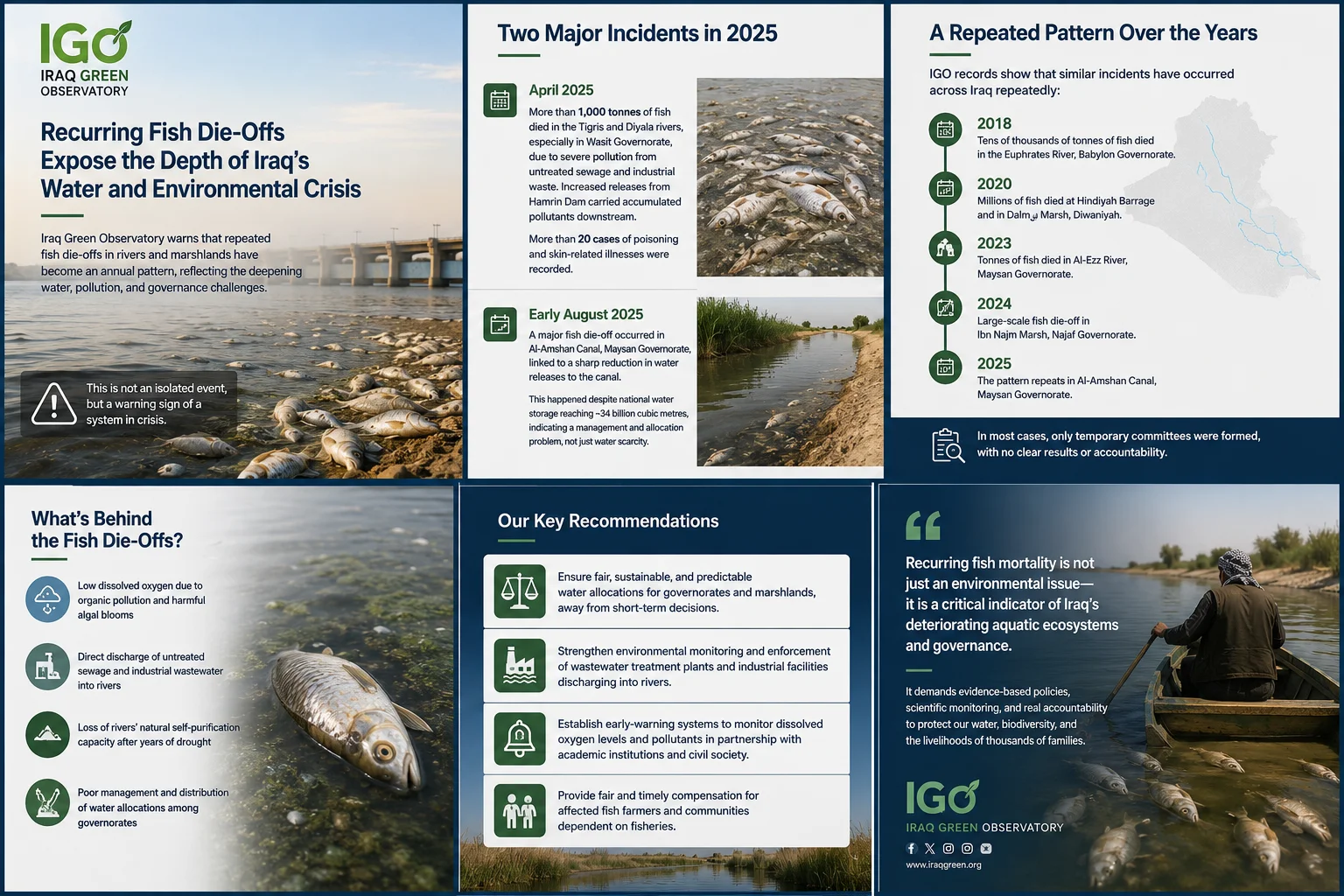
The Observatory noted that two major incidents have been recorded so far this year. The first occurred in April, when more than 1,000 tonnes of fish died in the Tigris and Diyala rivers, with the heaviest losses reported in Wasit Governorate. The incident followed severe contamination caused by untreated domestic sewage and industrial waste, coinciding with increased water releases from the Hamrin Dam, which carried accumulated pollutants downstream toward the Tigris. The contamination reportedly resulted in more than 20 cases of poisoning and skin-related illnesses, with affected individuals requiring hospital treatment.
The second incident was recorded in early August in the Al-Amshan Canal in Maysan Governorate. The Agriculture and Water Committee of the Maysan Provincial Council attributed the fish deaths to a sharp decline in the water releases allocated to the canal.
The incident coincided with announcements that Iraq’s total water reserves had increased to approximately 34 billion cubic metres, suggesting that the underlying problem is not solely one of water scarcity, but is also strongly linked to water governance and the management and distribution of available resources.
The IGO emphasised that these incidents are not isolated. Its records document a series of similar fish die-offs over recent years. In 2018, tens of thousands of tonnes of fish reportedly died in the Euphrates River in Babylon Governorate. This was followed by the deaths of millions of fish at Hindiyah Barrage, and subsequently in Dlmaj Marsh in Diwaniyah in 2020. In 2023, tonnes of fish died in the Al-Ezz River in Maysan, in the same area where a similar incident was recorded this year. More recently, extensive fish mortality was reported in Ibn Najm Marsh in Najaf Governorate last year.
The IGO pointed out that this persistent recurrence has, in most cases, been met primarily with temporary investigative committees, whose findings have not consistently produced definitive conclusions or resulted in accountability for the responsible parties.
According to the IGO, the recurring causes underlying these incidents include declining levels of dissolved oxygen resulting from the decomposition of organic matter and the proliferation of harmful algal blooms; the direct discharge of untreated domestic sewage and industrial wastewater into rivers; the reduced capacity of water bodies to naturally assimilate and purify pollutants following successive years of drought and reduced flows; as well as poor management of water allocations among governorates.
The IGO called on the relevant government authorities to establish fair, sustainable, and predictable water allocations for governorates and marshlands, moving away from short-term and reactive decisions. It also urged the government to strengthen environmental monitoring and enforcement at wastewater treatment facilities and industrial establishments located along rivers, and to establish an early-warning system capable of continuously monitoring dissolved oxygen levels and water pollutants in partnership with academic institutions and civil society organizations.
The Observatory further called for fair and timely compensation for affected fish farmers and fishery-dependent communities, stressing that the continued absence of structural solutions poses a growing threat to Iraq’s food and water security and risks further losses to aquatic biodiversity and the livelihoods of tens of thousands of families dependent on the country’s fisheries resources.
The IGO stresses that recurring fish mortality should not be treated as isolated or seasonal incidents. Rather, it should be regarded as a critical environmental and water-governance indicator requiring sustained monitoring, scientific investigation, institutional accountability, and evidence-based policy interventions.