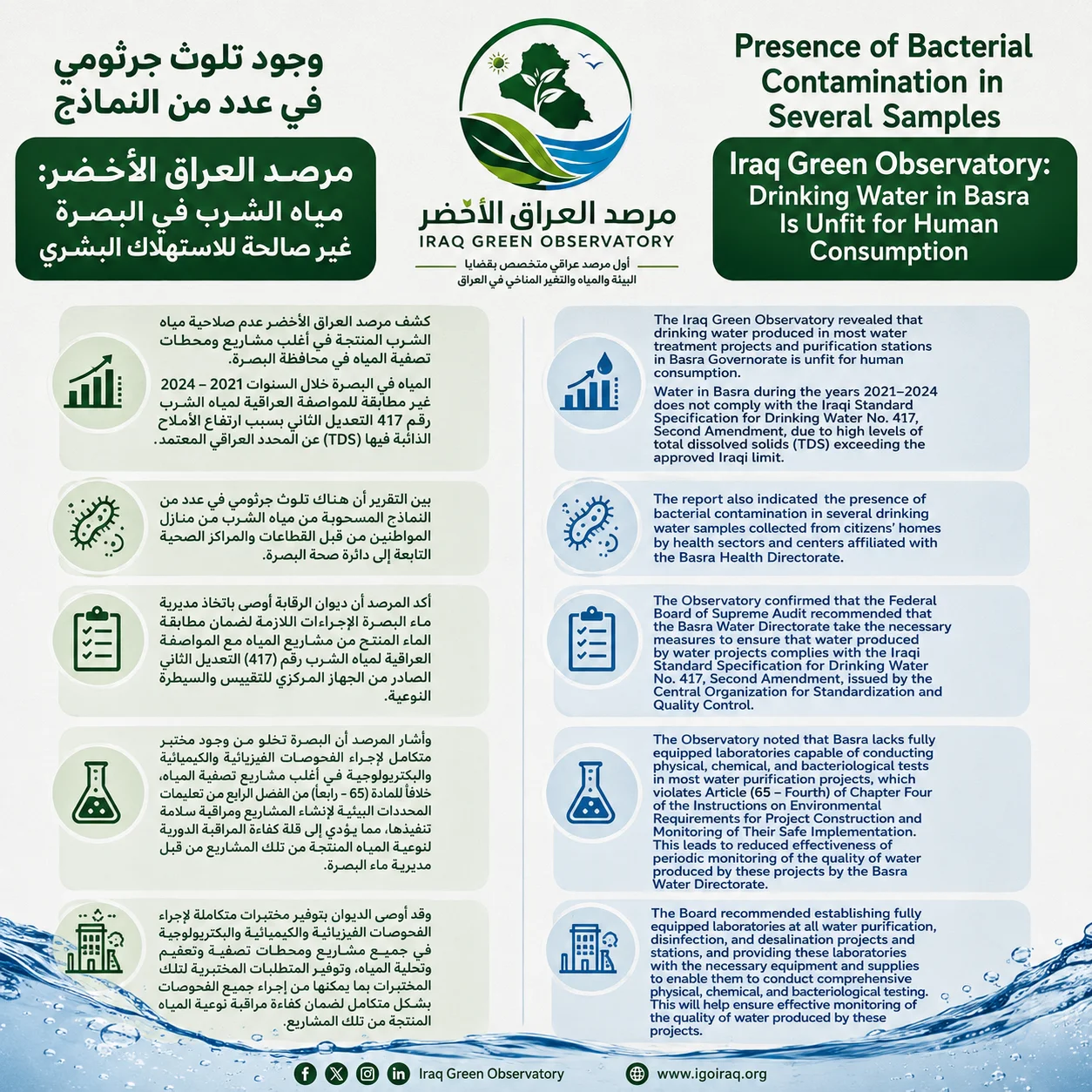
The Iraq Green Observatory (IGO) revealed that the drinking water produced by most water treatment projects and purification stations in Basra Governorate is unfit for human consumption.
The Observatory cited a report issued by the Federal Board of Supreme Audit last year, which found that the water in Basra Governorate during the period from 2021 to 2024 did not comply with the Iraqi Standard Specification for Drinking Water No. 417, Second Amendment, issued by the Central Organization for Standardization and Quality Control. The report attributed the water’s unsuitability for human consumption to elevated levels of total dissolved solids (TDS), exceeding the approved Iraqi limit.
The report also indicated the presence of bacterial contamination in several drinking-water samples collected from citizens’ homes by health sectors and centers affiliated with the Basra Health Directorate.
The Observatory confirmed that the Federal Board of Supreme Audit recommended that the Basra Water Directorate take the necessary measures to ensure that water produced by water projects complies with the Iraqi Standard Specification for Drinking Water No. 417, Second Amendment, issued by the Central Organization for Standardization and Quality Control.
The Observatory further noted that most water purification projects in Basra lack fully equipped laboratories capable of conducting physical, chemical, and bacteriological tests. This is in violation of Article 65, Fourth, of Chapter Four of the Instructions on Environmental Requirements for Project Construction and Monitoring of Their Safe Implementation. This shortcoming contributes to the limited effectiveness of periodic monitoring of the quality of water produced by these projects by the Basra Water Directorate.
The Board recommended establishing fully equipped laboratories at all water purification, disinfection, and desalination projects and stations, and providing these laboratories with the necessary equipment and supplies to enable them to conduct comprehensive physical, chemical, and bacteriological testing. This would help ensure effective monitoring of the quality of water produced by these projects.