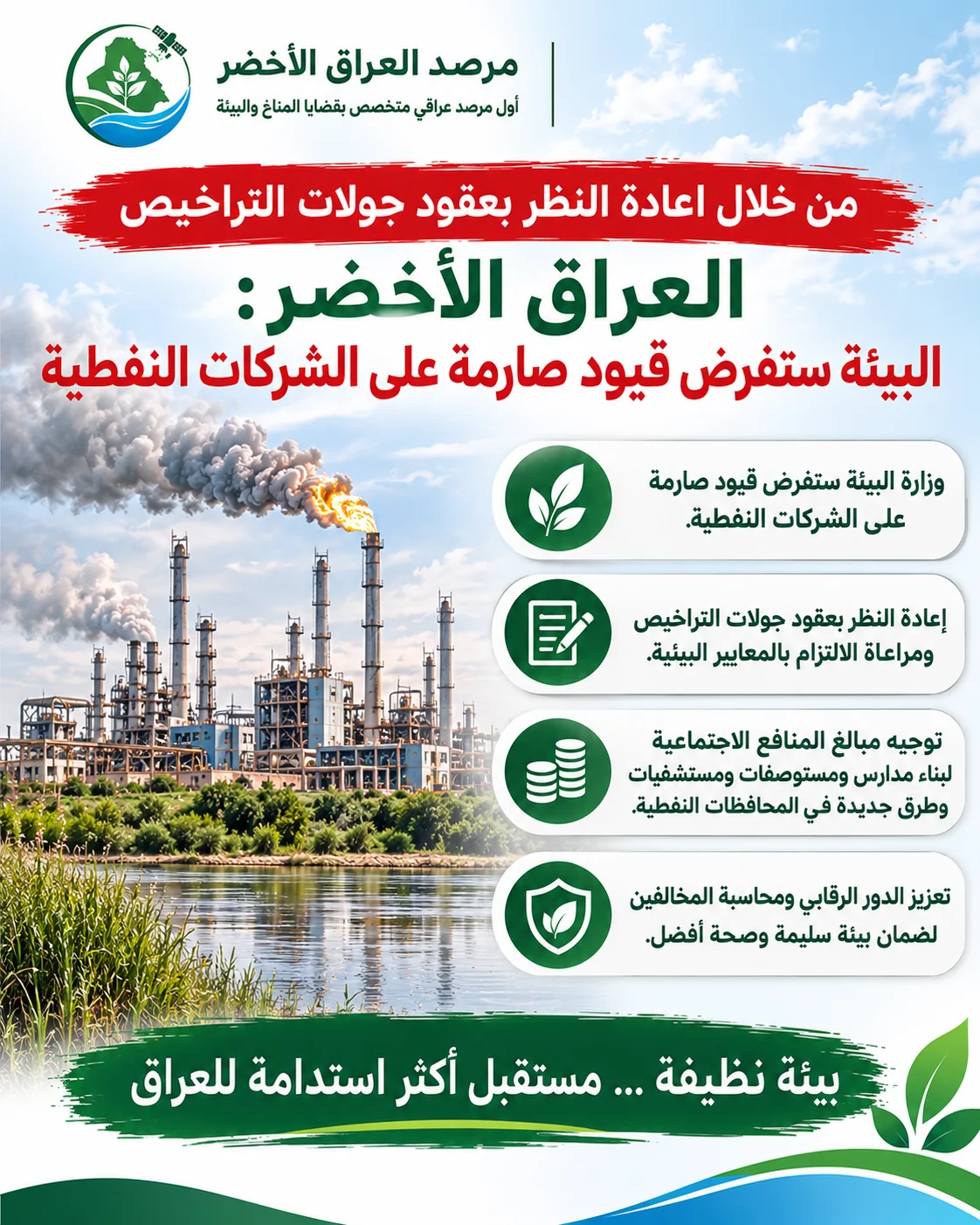
The Iraq Green Observatory announced that the Ministry of Environment will impose stricter environmental regulations on oil companies in the coming period.
The Observatory stated that, following Environment Minister Sarwa Abdul Wahed’s visit to Basra Governorate, where assessing the scale of pollution caused by oil companies was a key priority, these companies must be subject to unified environmental standards and effective, independent oversight. They must also assume their legal and environmental responsibilities for the damage resulting from their operations.
The Observatory added that the Ministry intends to take stringent measures against these companies and reconsider the contracts awarded under Iraq’s oil licensing rounds. It noted that Iraq had previously sought to attract oil companies by offering relatively flexible contractual conditions, often overlooking the environmental dimension. The Observatory stressed the importance of preparing reports assessing companies’ compliance with environmental standards and making these reports publicly available. Such transparency could affect the reputation of companies that fail to meet their environmental obligations when seeking oil investment contracts in other countries.
The Observatory also emphasized that the social benefit funds collected from these companies, estimated at USD 10 million annually, should be allocated to building schools, primary healthcare centres, hospitals, and new roads in the governorates where oil operations take place. It questioned how these funds had been spent over previous years and called for greater transparency regarding their allocation, particularly given that several areas of Basra continue to suffer from inadequate public services, a shortage of schools, and poorly maintained or unpaved roads.
The Observatory explained that the Ministry of Environment’s role should not be limited to identifying problems, conducting field visits, or issuing warnings. Rather, it must fully exercise its regulatory and legal responsibilities, monitor compliance with environmental requirements, hold violators accountable, and ensure that economic activities, regardless of their importance, are not used to justify continued harm to the environment and public health.
It further noted that assessing environmental improvement must be based on actual changes in pollution levels, continuous monitoring of air and water quality, reductions in emissions resulting from oil and industrial activities, and an evaluation of the effectiveness of measures taken to address pollution sources. Environmental progress should not be measured by the number of meetings, field visits, or announced projects, but rather by their tangible and verifiable impact on environmental conditions.
The Observatory raised several questions: Has Basra witnessed an actual reduction in airborne pollutant concentrations? Have water quality indicators in rivers and other water bodies improved? To what extent have emissions resulting from the flaring of associated gas during oil operations been reduced? And have regulatory measures led to a decline in environmental violations committed by industrial and oil facilities?
The Observatory also stressed that any discussion of environmental progress must be accompanied by a clear assessment of the Ministry’s regulatory performance over previous years, particularly given that oil and industrial activities in Basra are not new and their environmental consequences have been well documented for years. Accordingly, institutional accountability should not be limited to identifying current problems; it must also include clarifying which remediation measures have been implemented, which have stalled, and why certain sources of pollution continue to persist.
Finally, the Observatory indicated that the Minister of Environment is expected to conduct further field visits to Maysan, Dhi Qar, and other governorates hosting oil investments. These visits are intended to strengthen oversight of oil projects across the country and ensure a more active field presence by the Ministry during the coming period.
Translation note: The translation preserves the original statement's institutional and environmental accountability tone, while using terminology appropriate for professional media releases and international environmental communications.